

By Rick VanSickle
One long, breathtaking sniff was all I needed to realize that this was much more than a story about one of Canada’s rarest icewines.
This is a multi-faceted and fascinating tale about the very beginnings of Canada’s world renowned sweet treat, the race to make the first icewine, the criminal lengths some would go to get their hands on a single bottle and how the wine I was tasting on this day in Niagara-on-the-Lake with a man I had never met happened to have a bottle of one of this country’s rarest wines and was now sharing it with me.
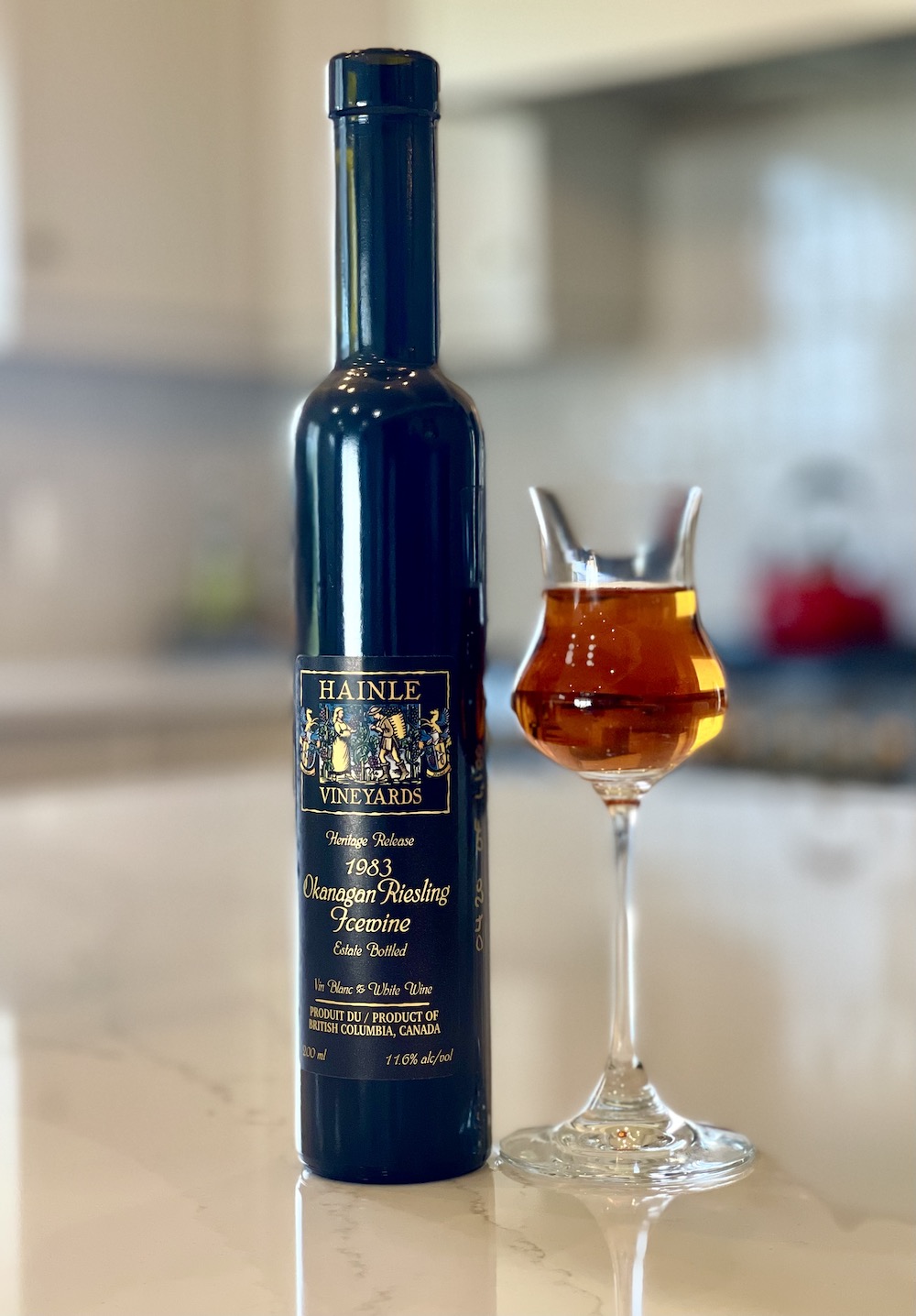
The wine I’m talking about is the Hainle Vineyards Heritage Release Okanagan Riesling Icewine 1983 from the Okanagan Valley, one of the last in existence on the planet (I know of one other, read on), and it nearly brought me to tears. It was THAT spectacular, and it surprised me beyond belief. because I was skeptical that it would even be drinkable.
THE HAINLE STORY

The Hainle Vineyards Estate Winery (vineyard above) is famous for many things — it was B.C.’s 8th wine estate in 1971, and Canada’s first certified organic winery in 1988 — but it is icewine that put the Hainle name on the wine map of the world. The family is credited with making Canada’s first commercial icewine, according to respected B.C. wine writer John Schreiner.
As Schreiner writes in his book Icewine: The Complete Story, published in 2001, it was in 1973, “before Walter Hainle took delivery of all the Okanagan Riesling grapes he had ordered from a grower in the Okanagan, an early frost caught them on the vine. He seized the opportunity to make between 30 and 40 liters of icewine. It became an annual tradition. In 1988, when the Hainle Vineyards winery opened, with his professionally trained son Tilman as the winemaker, the vintages for sale included 265 bottles of 1978 icewine. ‘My dad’s belief was that it always has to be a rare item,’ Tilman said. The majority of Canadian wineries, including Hainle, now make icewine each year, occasionally on the grand scale made possible by the famously cold winters.”
Walter Hainle was German, a former textile salesman from Hamburg who emigrated in 1970 when his doctor ordered a career change to cure a bad case of ulcers, according to Schreiner. “The prescription was sound. Before he died in 1995 in his 80th year, Hainle spent 25 vigorously productive years as the proud patriarch of a winery that he and his family established in British Columbia’s Okanagan Valley. Like most Europeans who arrived in Canada a generation ago, Hainle made his own wines because the Canadian table wines then available seldom pleased European palates. ‘He came at the whole subject of wine from an amateur enthusiast’s point of view,’ Tilman Hainle said of his father. ‘Growing some grapes on his own property and making some wine from it was a dream from a long time ago.’ ”
BEGINNING OF THE MODERN
ICEWINE INDUSTRY IN CANADA

The 1970s and 1980s were heady times with the origins of the modern wine in industry in Canada, and icewine was at the forefront of a promising new era.
Much of the credit for the booming industry today goes to a couple of men — Donald Ziraldo (above with Karl Kaiser) and Harry McWatters. And even though they toiled 4,200 kilometres apart, Ziraldo in Niagara and McWatters in the Okanagan, their goals were the same: to make 100% Canadian wines that would turn heads the world over.
In the early 1970s, Ziraldo said, Niagara wine producers were making “Canadian” wines with at least some labrusca grapes in the blend and imported grape juice from other countries. There were no rules that guided wineries and therefore no incentives to try planting the hard-to-grow vinifera varietals (noble European grapes that are common today such as Chardonnay, Riesling, Cabernet Sauvignon and Merlot) that worked well in other wine regions of the world.

After visiting relatives in Italy in the early 1970s, Ziraldo came home to Niagara and began experimenting with vinifera at his nursery. He and partner Karl Kaiser, an Austrian-born chemist, shared a similar dream and set out to seize on an opportunity — to grow and make wine from vinifera grapes.
Ziraldo grew the grapes — Riesling, Chardonnay and Gamay to start — at a little vineyard in Niagara and Kaiser, the winemaker, used the new grapes as the basis for these bold new wines. They received a manufacturing permit in 1974, and they were on their way. With wines to sell, and no new retail licences issued in Ontario since Prohibition, Ziraldo approached the Liquor Control Board of Ontario and convinced the government agency to grant them the first licence since Prohibition in 1929, thus ending the dominance of the six big blending wineries that controlled the only licences in Ontario.
With a means to sell their wines and a commitment to make 100% Canadian wine from vinifera grapes, Ziraldo and Kaiser started up a boutique winery in 1975 called Inniskillin, opening the door for others to follow. It started what is today the modern wine revolution in Canada.

Canadian wine, prior to the 1970s, was anything but “civilized.” It was, with a few exceptions, horrid swill, a combination of labrusca and other native grapes that grew vigorously but produced barely drinkable wines.
For most of the 160+ years that Canadians have been making wine (the first commercial winemaking operation in Canada began in 1866 on Pelee Island in southern Ontario), it is only within the last few decades that Canadian wines have gone from domestic obscurity to international superstar, able to compete with some of the finest wines in the world.
BACK TO THE ICEWINE WARS
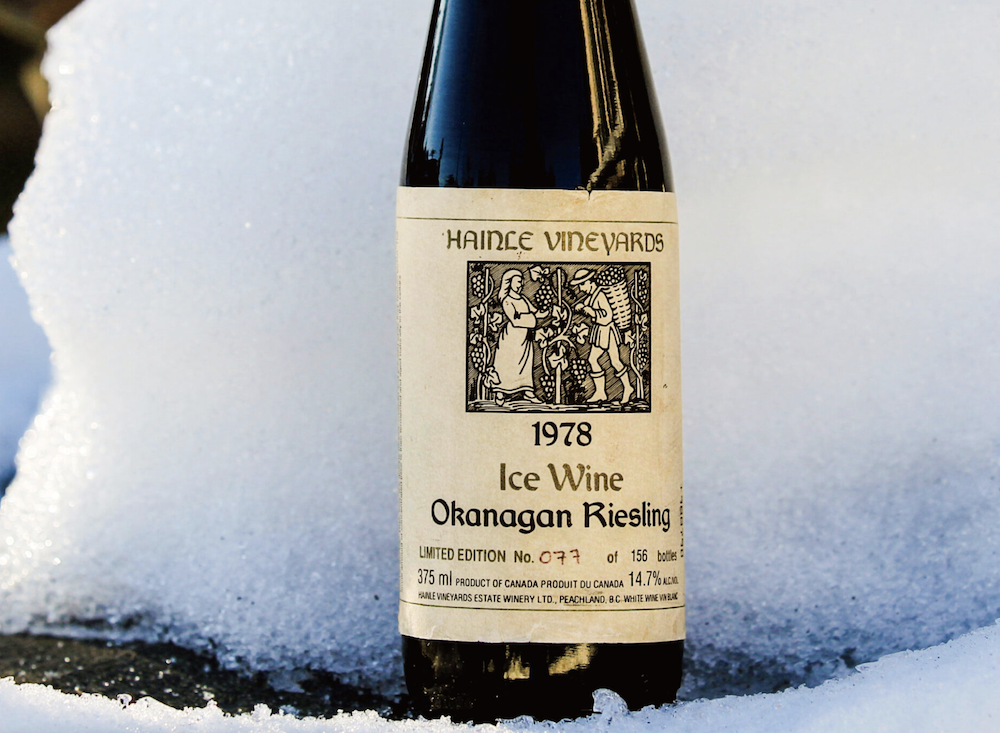
According to Schreiner’s well researched book, “Walter Hainle made his first icewines from a grape called Okanagan Riesling, a vine of uncertain origin which formerly was the ubiquitous white variety in the Okanagan. Some believed it to be a vine imported in the 1920s from Hungary. More likely, it was a chance hybrid with native labrusca grapes in its parentage. A hardy and productive vine, it yielded rustic and mediocre table wines; the icewines from the variety only were marginally better, possessing pungent aromas that recalled inexpensive after-shave lotion. There was nothing subtle about an Okanagan Riesling icewine; it was the wine’s exotic character that created a sensation among the friends who sampled Walter Hainle’s creations. When he purchased raw land on a slope above Peachland as the foundation for the family’s future winery, Hainle planted the true Riesling.
“By the 1990s, Okanagan Riesling had been eliminated almost totally from British Columbia vineyards in favour of vinifera vines, all of which make better table wines and, in some cases, excellent icewines as well. In 1982, after his son Tilman returned from enology studies in Germany, the Hainle winery began making icewine only with the true Riesling. For the next decade, only two wineries in British Columbia made icewine regularly: Hainle in the Okanagan and the reclusive St. Lazlo winery at Keremeos in the nearby Similkameen Valley which also began making icewine in 1982. It was only in the 1990s that other Okanagan wineries, encouraged by icewine’s rising star in Ontario, went down the path blazed by the Hainle family.”
MEANWHILE, OVER IN ONTARIO

Schreiner said that it was only “keen amateurs who began icewine trials in Ontario. “A young winemaker named Peter Gamble, then working with a cottage winery now known as Hillebrand Estates, made icewine when grapes were offered to him for personal winemaking from a vineyard with unharvested second-growth Riesling. It was typical of amateurs that they scavenged what the commercial wineries had left behind. ‘This was, however, just a personal batch, not anything specifically for Hillebrand,’ he stressed. He got enough juice to fill a 25-liter glass carboy which he placed in a home sink to ferment. Unfortunately, the carboy tipped, broke its neck and Gamble lost the juice down the drain.”
In 1983 Ontario, icewine making lurched into the hands of the professionals, Schreiner said. “At a vineyard beside the Niagara River, Inniskillin’s Austrian-born winemaker Karl Kaiser and a neighbouring German-born grower named Ewald Reif set aside several rows of Vidal for icewine, none of it protected with nets. ‘I didn’t know where to buy nets here,’ Kaiser admitted later. ‘And I didn’t know how ravenous the birds were either.’ The birds ate all of the Vidal. Meanwhile, Walter Strehn, another Austrian and the winemaker at the new Pelee Island winery near Windsor, had the foresight to import netting from Europe that year for the vines he set aside for icewine on Pelee Island, a 4,000-hectare island positioned in Lake Erie on two major migratory flyways for birds.
“He draped the white nets across at least eight rows of vines, protecting a quantity of grapes that, if made into icewine, would have created a considerable sensation. The netting worked too well, trapping birds as well as protecting the grapes. Strehn’s nets were dismantled by conservation officers from the province’s Ministry of Natural Resources, who charged Strehn with trapping birds out of season. While the charges were dropped later, birds ate about $25,000 worth of Strehn’s unprotected grapes, primarily Riesling. Even so, he salvaged enough Vidal to make a commercial quantity of icewine in 1983, shipping about one hundred cases to the Liquor Control Board of Ontario where the wine retailed for $12.50 a half bottle. After little was sold, the LCBO returned it to the winery for refund. Subsequently, Pelee Island found more remunerative markets in the United States and when the icewine began selling there for more than $100 a bottle, the LCBO begged to have it back.”

Others in Ontario were also chasing and perfecting (sometimes failing) icewine production. Hillebrand made its first icewine in 1983. The winery had been started in 1979 as Newark Wines, according to Schreiner, by an engineer named Joseph Pohorly who sold control of the winery in 1982 to a large German firm. “Jurgen Helbig, the young German winemaker dispatched to work with Pohorly at the winery, saw the grapes left hanging by Reif and Kaiser in the 1983 vintage and also decided to make icewine. ‘They chickened out,’ Kaiser said. ‘They harvested the grapes in October and put them in cold storage and brought the grapes out in bushel baskets in December.’ The grapes spent a month or so in a cool room, secure from ravenous birds, and were placed outside overnight on a December evening when the mercury dropped below -10 C. They were pressed outside the next day. ‘There were no rules,’ Pohorly defended himself later, pointing out that the grapes had not been frozen artificially. Sixty cases (12 half-bottles per case) of icewine were produced that year by Hillebrand.
In 1982 Klaus Reif made his first Eiswein as an apprentice at a state winemaking school in Neustadt, Germany, said Schreiner in his book. “ ‘I thought it was very special,’ he remembers. The juice that dripped from the press has a sugar concentration of 36 Brix, double the sugar concentration that German growers usually require for conventional Riesling table wines. Armed with newly acquired winemaking skills, he came to Canada in 1987 to help his uncle, Ewald Karl Kaiser’s friend who had opened a winery that Klaus since has taken over.
After the 1983 fiasco, Kaiser and Reif had both deployed nets in 1984, and icewines began to emerge each vintage. The volumes at first were modest as the winemakers learned the art. Young Klaus Reif (he was born in 1963) arrived at his uncle’s winery in time to help bottle the 160 liters made in 1986 and then to take charge of pressing the 1987 vintage.”
By the mid to late 1980s, many wineries in Ontario were well on their way to making icewine every vintage. With Reif, Inniskillin and Hillebrand wineries leading the way, others now edged into icewine production, including German-born Herbert Konzelmann, Willowbank, which was absorbed later by Marynissen Estates, followed by Château des Charmes and Vineland Estates in 1988. Said Schreiner in his book, “ ‘The guys that jumped into it first were the German group,’ says Paul Bosc Jr., a member of the family the operates Château des Charmes. ‘Our extraction is French, and we just found it very strange. Why are these guys picking grapes in the wintertime? We thought we worked hard enough as it is.” His father, Algerian-born Paul Bosc Sr., had come to Canada in the mid-1960s after the war in Algeria forced out French winemakers like himself.
“The family’s subsequent success, now evident in their grandly conceived winery near Niagara Falls replicating a Loire chateau, came from being alert to opportunity. In 1988, convinced that icewine was gaining acceptance, they made 200 half bottles of Riesling icewine and priced it aggressively at $40 a half bottle. ‘In the first couple of years, we stayed within ourselves,’ Paul Bosc Jr. recalls their learning experience. ‘If we did screw it up, we would not have told anybody we even made it.’ The wines succeeded, the Boscs being capable winemakers, and production expanded until, in the bountiful 1998 vintage, Château des Charmes made 140,000 half bottles of icewine.”
REVOLVING OWNERSHIP AT HAINLE

The Hainle family sold the winery in 2002 to Walter Huber (above), a Munich-born businessman who had been sent by his family to run a fishing lodge in Dryden, Ontario, according to Schreiner. “He was more interested in winegrowing. He tried to rebrand the winery as a Deep Creek Wine Estates. He also flailed around with strategy, at one time producing as much as 10,000 cases of wine and then shrinking production to 1,500 cases of well-aged premium-priced wine. In 2013, after the winery barely escaped being destroyed in a forest fire the previous autumn, Walter lamented that he had to release some wines early just for cash flow. ‘But I don’t really like doing that,’ he told me at the time. ‘I like to release my whites when they are three for five years old and my reds when they are seven to 10 years old. What I am doing is old style European wine aging.’ He was also tying up money in inventory that had to be recovered with aggressive wine pricing.”
There has been a significant turnaround at Hainle since this historic property was acquired from Walter Huber in 2017 by Bella Huang, a Chinese-born entrepreneur who is a hands-on winery operator, said Schreiner. “Since then, the Peachland winery has replanted its vineyard and fully renovated the winery, installing new tanks, barrels and winemaking technology. Consulting winemaker Anthony Buchanan was engaged to make the vintages relaunching the brand. Subsequently, he hired Scott Ingram as Hainle’s resident winemaker.”
BACK TO THAT 1983 ICEWINE

In November 2013, when Walter Huber owned the winery, thieves broke into the winery and stole $30,000 worth of icewines, including a 1983 and 1984 Hainle icewine, worth $10,000 and $8,000 respectively.
“So, he basically came in through the back door here and somehow they opened it,” Walter Huber, owner of Hainle Vineyard, told Global News in 2013. “They obviously tripped off the alarm system, so they had very little time to get in here.”
Huber’s winery was featured in a Global Okanagan story about icewines the Friday before the wines were stolen. “While we can’t be certain there’s a connection, Huber says many of the wines featured in the story were targeted by the thieves,” said Huber.
He told Global that the one product they were after was a 1978 Riesling icewine, an extremely rare wine, one that has the title of first commercial ice-wine produced in North America. He’s appraised it at $1 million a bottle. “They looked for the 1978 icewine, but they couldn’t find it in the safe,” said Huber.

Huber had been snake bitten in recent years. In 2006, one of those rare 1978s was stolen after his vehicle was broken into in the Lower Mainland.
Then in 2012, during the Peachland fires, the historic Hainle Vineyard — where the Okanagan’s very first icewine grapes were grown — was destroyed. Huber said losing those wines isn’t just about the money because he’s insured, it’s about losing an important piece of Okanagan history. Those wines were never recovered.
A MAN OF MYSTERY AND
A TASTE OF HISTORY


I receive a lot of emails on this website, many of which are published, some of which go directly to spam and then the odd one that gets my full attention.
“I have a 1983 icewine from Hainle Winery. Hainle Winery was the first to produce ice wine in North America (see their website),” read the comment from “Bob.” That is not his real name, and I have agreed to not identify him for the purpose of this story, for obvious reasons (see above for the theft vignette).
After some toing and froing, which included me trying to figure out the origin story of wine and Bob’s motives for reaching out, we connected by phone after I proposed to him doing a story about the 1983 Hainle icewine for publication depending on how the wine held up after all these years. But to do that, we would have to taste it, a big ask, I know, but that is the at the heart of the story. Bob quickly agreed and we set up a tasting at his home in Niagara with his wife in attendance.
Bob retired to the Okanagan Valley in 2004 and did occasional work helping distressed wineries with their accounting and wine inventory controls. One of his clients was the Hainle winery, then owned by Walter Huber.

The winery paid Bob a nominal salary and but would often get bottles of wine as part of his compensation. It turns out that the new owners had recently found a few cases of well-aged icewines in a cluttered, dusty basement, including wines from 1983 and 1984, and he was offered a few bottles. Those older icewines, said Bob, “were all almost thrown out.”
Bob worked there for two years and eventually moved to Niagara with his wife and brought the wines with him. They have been stored in a cooler since he acquired them. The last time he tasted the wines was in 2005, soon after he received them. When I met Bob and his wife, he had two of the 1983s, one of which we were about to taste, and one 1984.
“I can say that these are the only two in the world,” Bob said. Now I don’t know if that is accurate, but I suspect it’s very possible. To be here on this day, about to taste it, was surely as exciting for me as it was for Bob and his wife.
In talking to him in his home, his motive for sharing his story and the wine is to hopefully find a good home for his last two bottles of icewine, preferably by someone who appreciates the history of the wines. He reached out to the current owners, with no luck and others, but there was little interest. And that’s where I come into the story.
A MAGICAL MOMENT, A 100-POINT ICEWINE

I arrived at Bob’s home with a bottle of my own to share, a 1997 Inniskillin Icewine that had been aging in my cellar, not a 1983, of course, but a nicely mature bottle to compare.
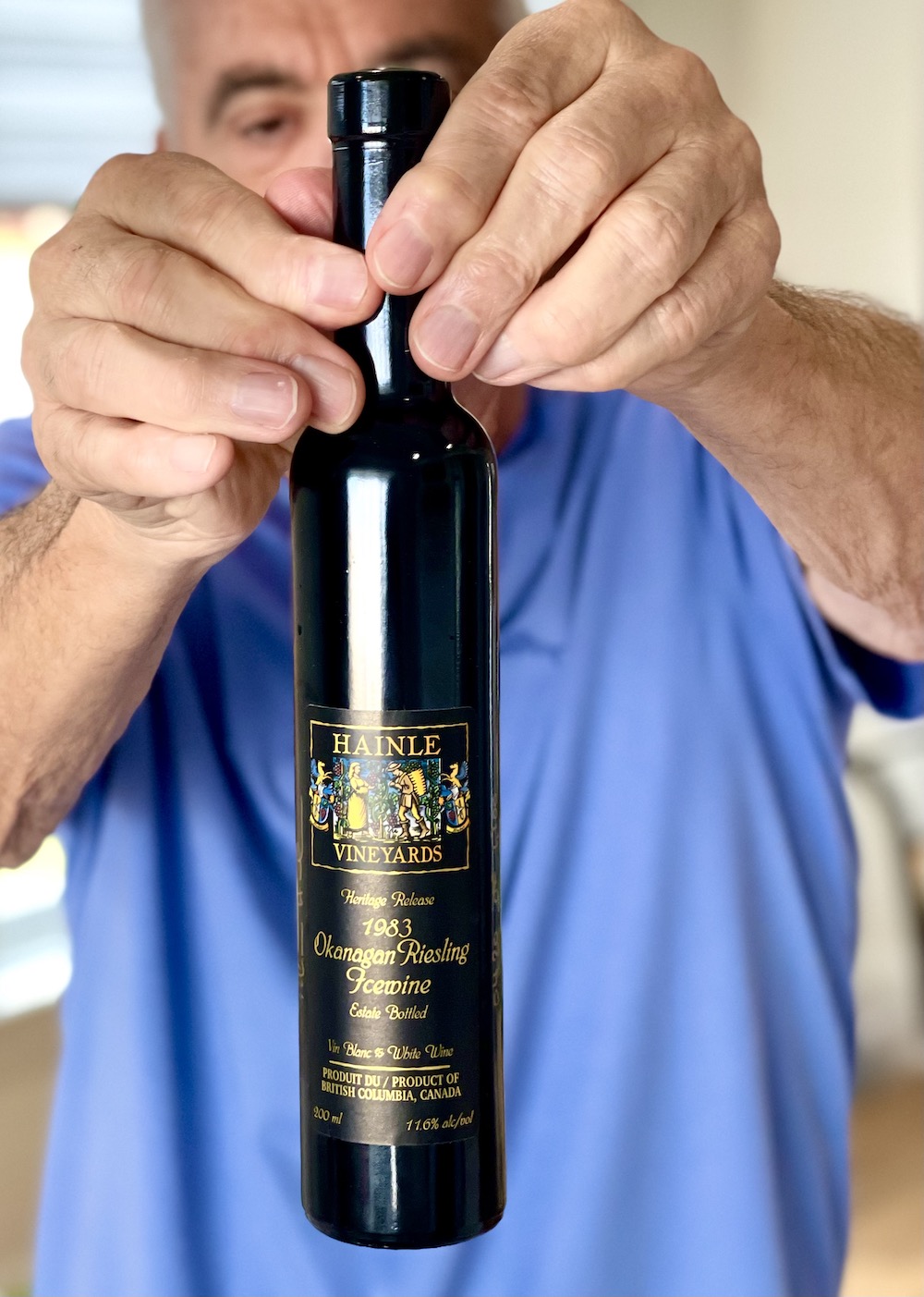
Bob brought his out his chilled bottle, which came in a beautiful wooden box with a wax topper covering the cork. It was in immaculate condition with full ullage and the label in perfect shape. I was surprised to discover it was a 200 mL bottle, which I immediately thought would give it less of a chance to survive 42 years.
The official name was Hainle Vineyards Heritage Release Okanagan Riesling Icewine 1983. It was noted as a “Product of Canada” and on the label it was inscribed and handwritten as one of 420 of 1,100 bottles and signed by the winemaker Tilman Hainle.
The back label read: “Early in the morning of December 3rd, at -11 C, Walter and Tilman Hainle along with family and friends picked, crushed and pressed one ton of Okanagan Riesling grapes for this Icewine. The result was 220 litres of concentrated, intensely sweet juice, with 37% sugar. Over the next months the wine fermented to 13% residual sugar. The wine was left to age in the winery’s cellars for 19 years, which resulted in prominent caramel, honey and nutty characteristics, and much complexity. A total of only 1,100 bottles containing 200 mL were released in December 2002.” When it was first released it was the oldest, and also the most expensive real Icewine to hit the market at $245 a bottle.
I had brought with me the trusty Durand bottle opener, designed just for older bottles like this, but it wasn’t necessary. As I gently removed the cork, twisting and pulling, it was liberated in perfect shape. Bob did the honours of pouring this historic bottle into three glasses to finally taste it.

It was a dark amber colour, to be expected, with perfect clarity. Our pours were generous, and the three glasses pretty much emptied the entire bottle.
I admired the elixir in my glass for a while and nosed the icewine, while Bob went straight to the first sip. In perhaps, as it turns out, the biggest understatement of the year: “It’s drinkable!” And he laughed out loud, as did we all.
This was magical. The nose was enthralling, a borderline miracle, with dried apricot, marmalade, creamy caramel, nutty marzipan, peach cobbler, compoted tropical fruits, fruit cake, quince preserves, butterscotch and honey. The aromas kept coming and I kept breathing it in, not believing what I was experiencing.
And then I tasted it. Without a doubt, this was the best icewine I have ever tasted. At this stage a 100-point wine and the reason we should all age our icewines. With all the descriptors above, on the palate it was all of that plus a viscous, satiny texture, a luxurious finish that lasts for minutes (I can still taste it), finessed and remarkably fresh. Yes! Still with racy acidity and remarkable life still to come. From all the sweet wines I have tasted, is the holy grail of icewines, a unicorn wine that has no business being this good. It was an experience I won’t soon for forget.

We then opened the Inniskillin 1997 Icewine (375 mL bottle) to compare, and it was a special wine as well. The cork came out easily and poured a much darker amber colour and had signs of nearing, or just slightly past, prime time. But still, it had beautiful compoted tropical fruits, molasses, creamy caramel, brown honey notes, figs, apricot tart and a more rounded, less finessed, finish. An amazing icewine but bested on this day by the 1983 Hainle.
EPILOGUE AND THANKS
I write this piece with the hope that Bob can find the right person to care for the two Hainle icewines, someone who appreciates the history and understands its place in that history.
I also want to give thanks John Schreiner for allowing me to liberally quote passages from his fabulous book Icewine: The Complete Story. John is a legend in the Canadian wine writing world and always generous with his time and insights. Thank you, John.
I came across this link by accident a few minutes ago and read on because I was in the winery with Walter Huber, filming my TV program many years ago. I bought a bottle of the 1983, and Walter opened one immediately after that, and we shared. I still keep the bottle because of the story of how I came to own it. Fond memories!!