
By Lidija Biro
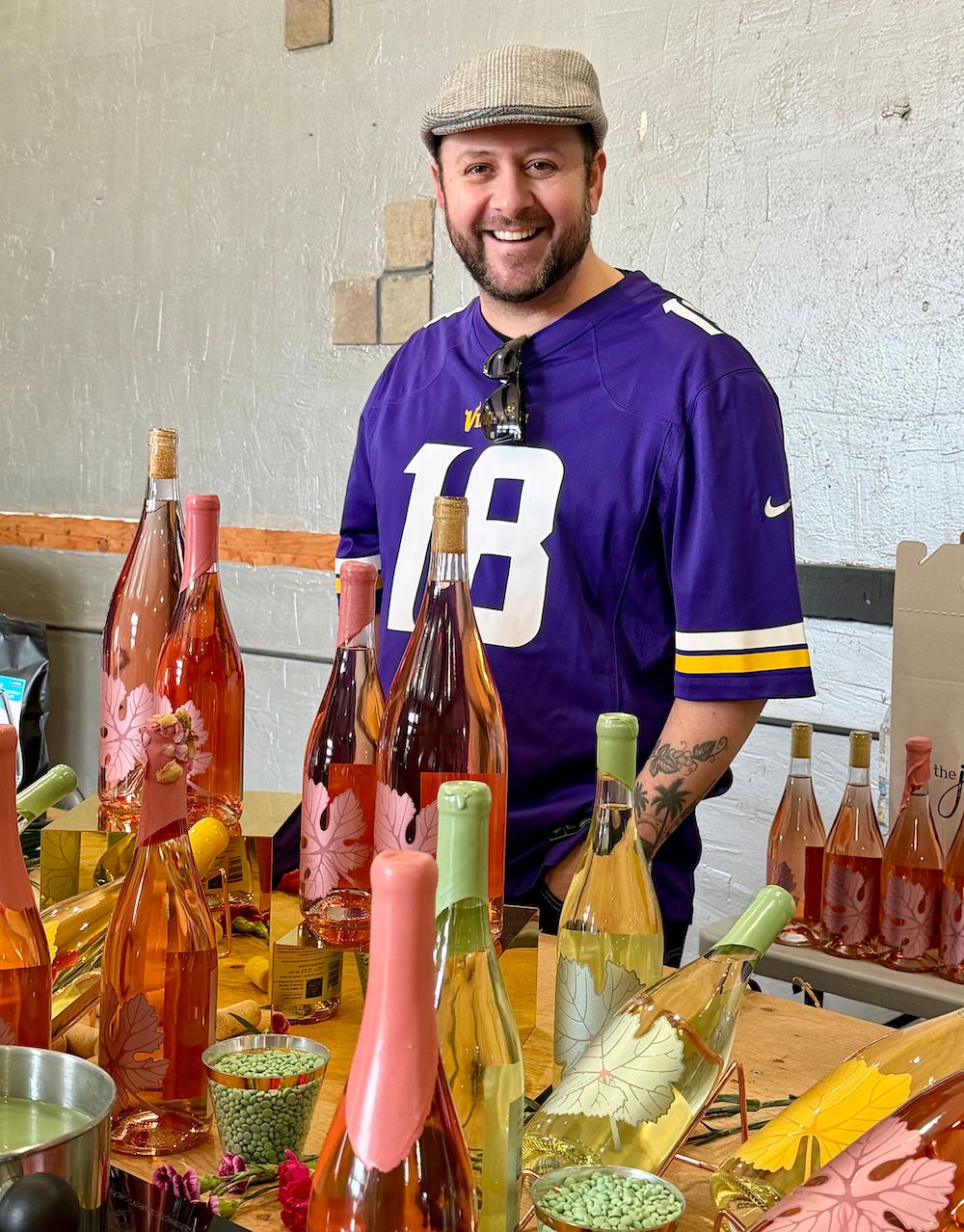
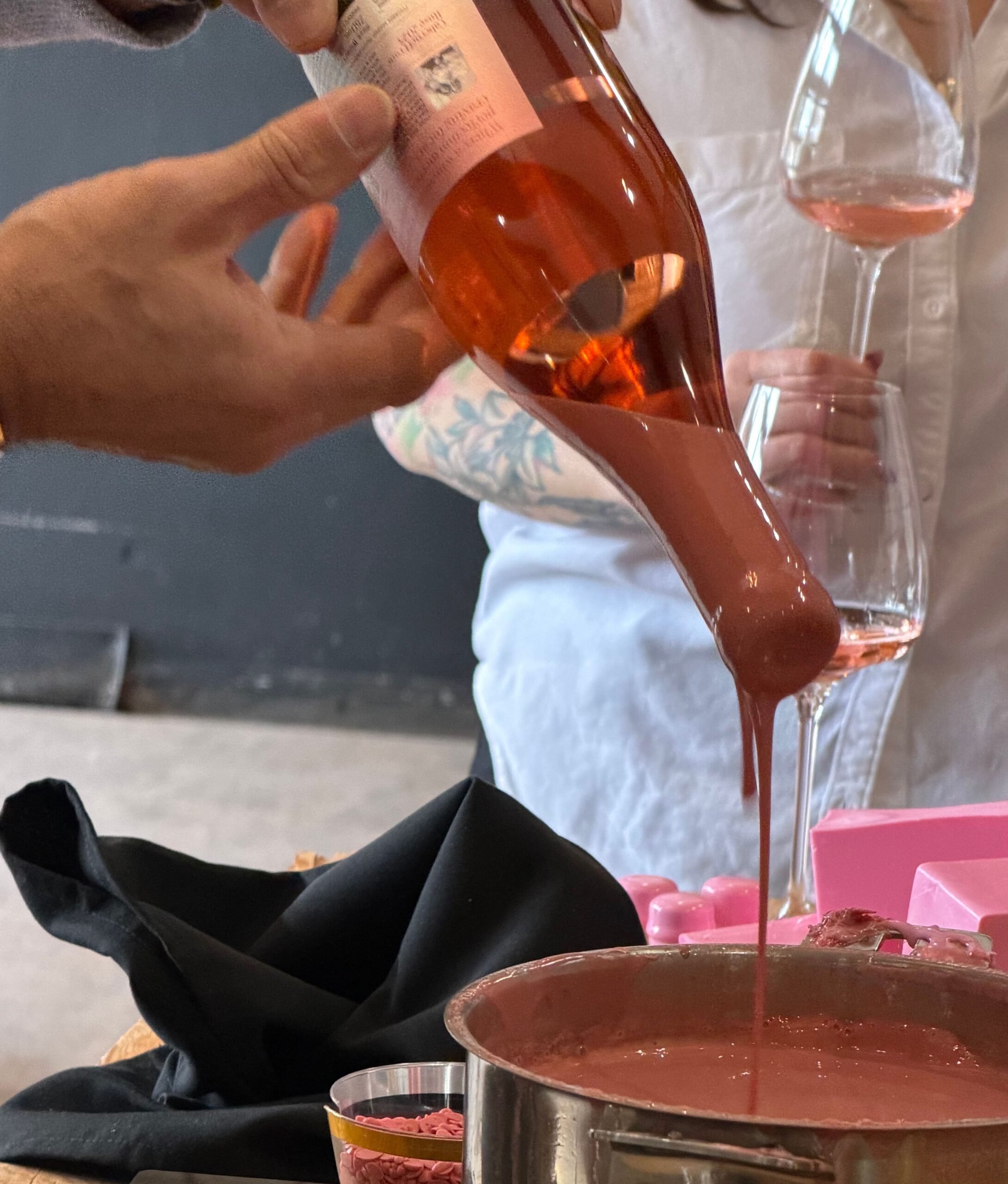
The Juice Wine Company held a fun event recently in Niagara for their partners and customers with a hands-on opportunity to wax dip bottles of the newly released 2025 wines.
The new wine brand, which operates out of the Niagara Custom Crush Studio, was founded by owners Angela Aiello (marketing guru and sommelier) and Ryan Zanette (winemaker), who are also partners in life.
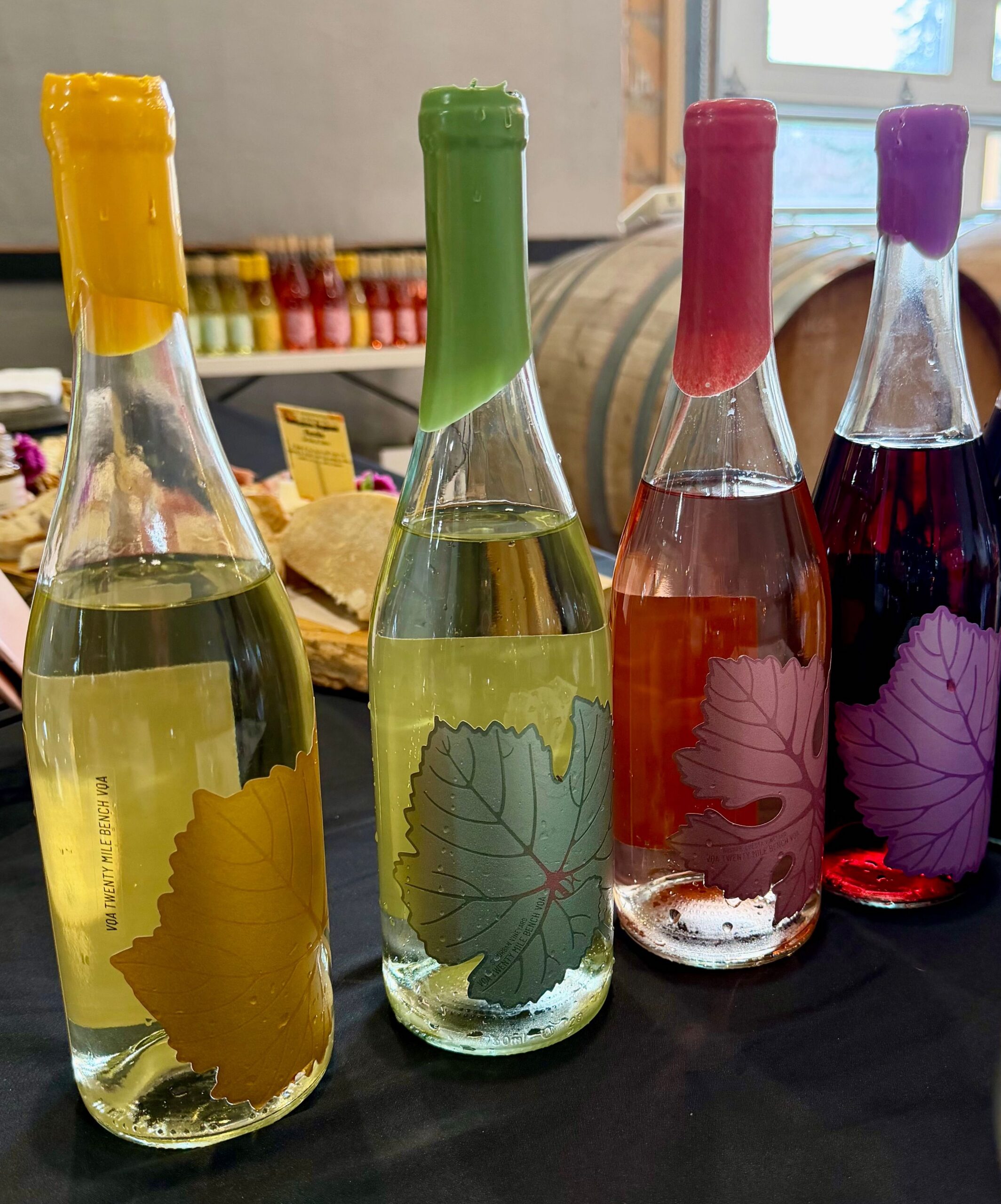
Their company’s motto — Where Winemaker’s Pursuit of Perfection Meets a Sommelier’s Craving for Art — refers to the quest for quality in their wines as well as to their unique, aesthetic wine labels.

Wines in Niagara contributor Lidija Biro was invited to the waxing party … and, no, not the hair removal kind! This is Biro’s conversation with the couple on the exciting new venture and where they see it going.
Wines in Niagara: Your wine labels are unique as are the colours you’ve chosen for the wax seal. What are the reasons behind these choices?
Ryan Zanette: The Juice Wine Company’s branding bridges tradition with innovation. So, essentially, tradition refers to back before people had books to identify grape varieties. They learned a skill called ampelography — identifying grape leaves — to understand what’s in the vineyard. I fell in love with that kind of vibe and that history.
We learned how to do ampelography and we’re bridging that to a modern day look of pastels and plum pinks. For example, a cool thing about the Riesling label is not just the shape of the Riesling leaf but the red eye. So, if you’re in the vineyard and see a red dot at the petiole base or sinus of a grape leaf, you can identify it as Riesling because it’s the only grape that has a red eye.
Essentially, we’ve bridged old school ways to New World and New Design vibes. People gravitate to colour. Your dad likes the purple wax. Or you’ll get somebody that likes the green. You bring out people’s personalities by not only the juice inside.
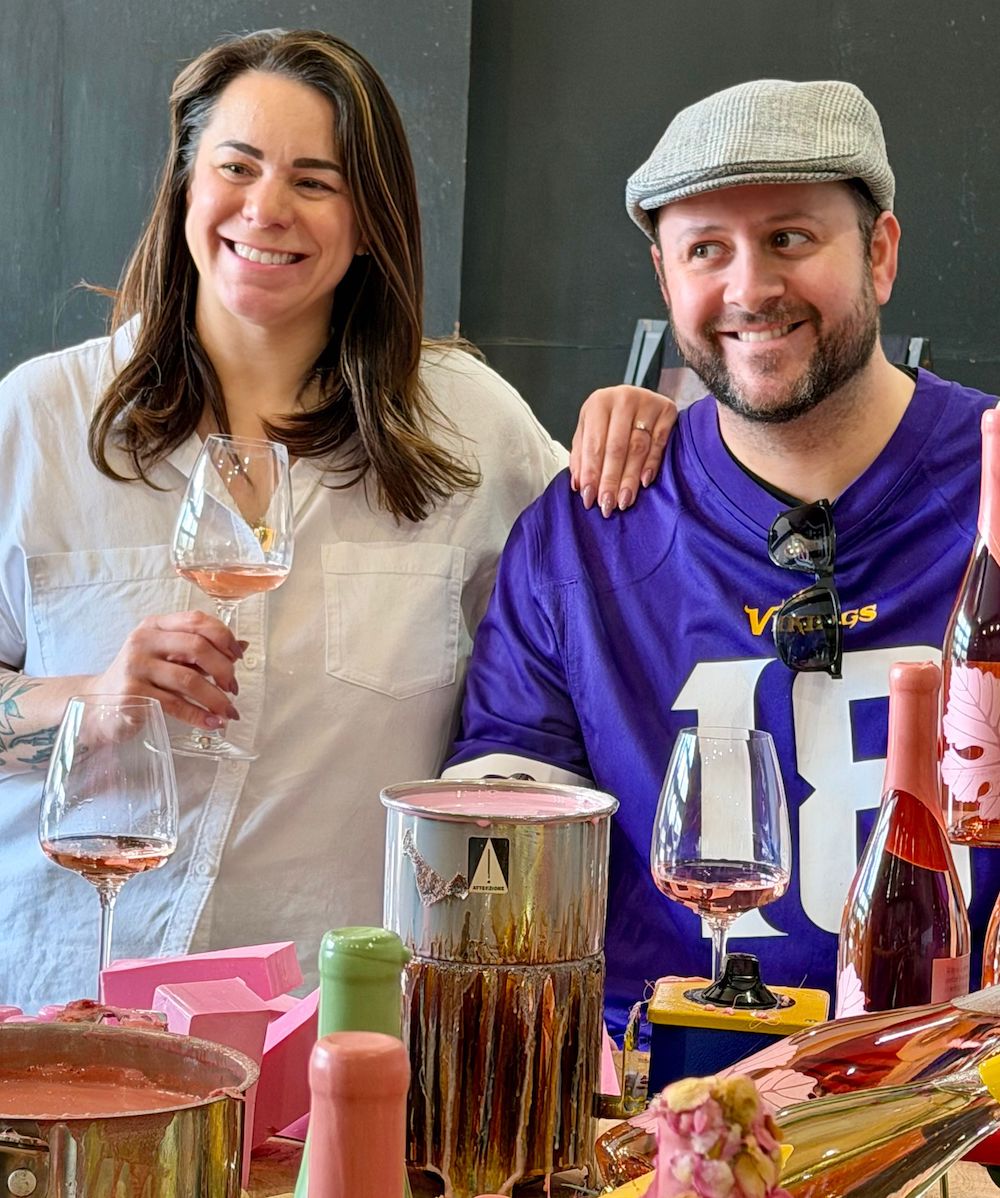
Angela Aiello: In fact, VQA had a hard time approving our labels because the look is so modern. I always say that the modern part of us is we drink with our eyes. The traditional part is we’ve made minimal intervention wines. We’re really showcasing the vineyard and the grapes in a non-manipulated way.
But the idea of how to sell wine, I think kind of loops people in the brain. For instance, I was at a Wines Australia tasting the other day, we were tasting 37 wines. And they all looked the same — the white label with black writing. We said let’s do something different but also educational. You know, our slogan is where Ryan’s pursuit of perfection meets my love of art. And I think there is depth to our story.

WIN: Both of you have busy, successful careers, so why start your own wine brand?
Aiello: I guess it’s a dynamic answer because I feel like I’ve been around the world. Both of us have been on all sides of the wine business. But the one thing we haven’t had is a brand we could build from scratch. We both know what restaurants like, what we like, what the trending psychology of wine is right now. And there is an all-Canadian trend. So, it was perfect timing.
We’ve always had an inkling that we wanted to do something like this. Everybody keeps saying, it was inevitable because I grew up around the corner (in Niagara). I spent 20 years in Toronto and now I’ve come back home. It was never really something I thought, to be honest, that we’d ever get to do. Making wine is a rich man’s world. So being young, you just think, ‘Maybe when I’m 60 or something.’
It was also due to Graham Rennie, who owns Niagara Custom Crush Studio. Graham called one day and said he wanted some marketing consultant work and really wanted me to be involved. I was at home with my 6-month-old at the time and I started thinking how can we be involved? Ryan and I would really love to make wine. How can we make that happen for a price that young, new parents who don’t have big savings can afford?
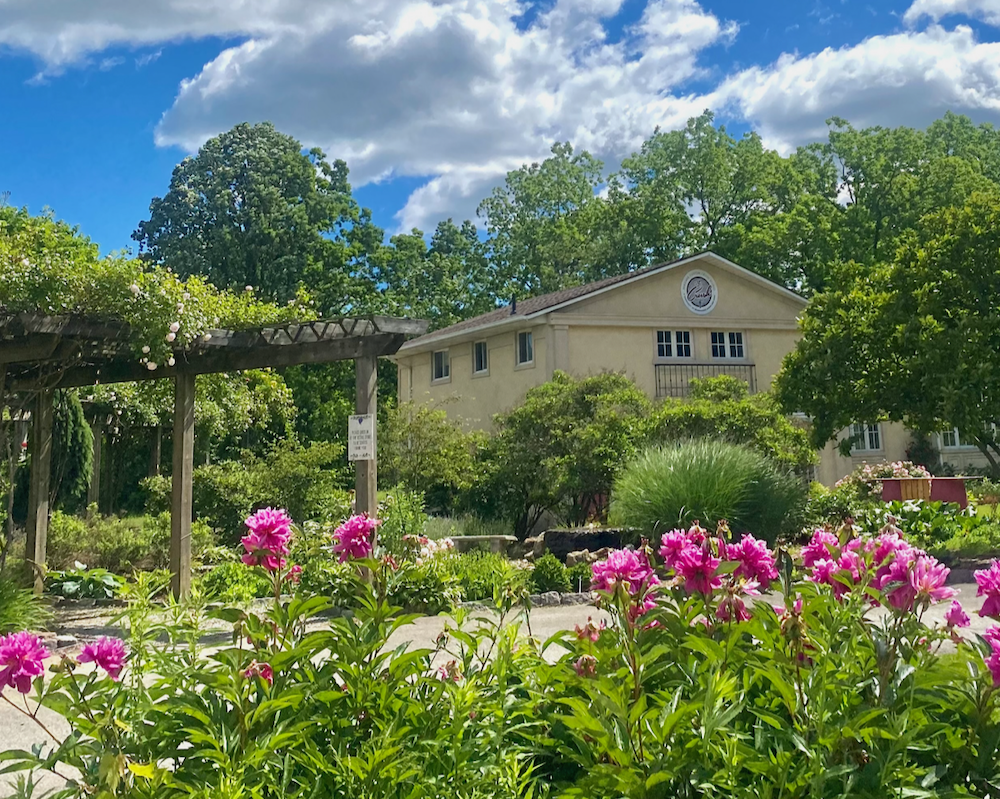
Juicy fact No. 1: Niagara Custom Crush Studio (or The Crush) is a collective of independent brands and winemakers producing a broad range of high-quality wines sourced from some of the most exceptional vineyards in Niagara. Established in 2022 it is a state-of-the-art production facility. Currently there are over a dozen wine brands making wine available for tasting all under one roof.
Back to Aiello: Graham (also owner of Rennie Estate Wines and Vineyard) and the team at Crush were flexible enough to make it work with us. It also solidified for me Graham’s vision of what he wants for this winery. I built four or five companies before this, so I’m kind of always in startup mode. It’s my favourite place to be.
Now, we’re here, making our own wine, we put a lot of heart, time and effort into the branding. In our test pilot year (2024), we sold out. We sold out of our rosé within three weeks. We sold out all of our wines, Chardonnay is actually the only one that’s left.
With everything happening on the tariff side of the business, my agency work was down 50%. So, it was the right moment. I had the time to really put into conceptualizing something that was beautiful and amazing.
At the end of 2025, we incorporated our pilot project because it was doing so well. We brought in shareholders and now we’re builders here at the Crush. It’s been a dream come true, really.
WIN: You know the old saying, wine is made in the vineyard. Obviously, you don’t own a vineyard. So, who do you source from and why do you source from those vineyards?
Zanette: We focus on low intervention, vegan wines. We want the vineyard to speak to it. And since we know the vineyard sites so well, we really look hard at what we think is a Grand Cru vineyard in our own world … not necessarily in VQA regulation standards, but in our own world. And we source out those specific vineyard sites.
So, for instance, our flagship product, a rosé, comes from Wismer Cuesta Vineyard. The Wismer family is a really prominent grape growing family in Niagara. Cuesta is a small plot essentially on the escarpment. Thomas Bachelder says it’s good. He says the Grand Cru vineyards in Niagara are 380 metres above Lake Ontario. So that’s this middle pocket of the appellation, essentially the Benchlands. He thinks up here is where it’s at.
Also, we made a one-of-a-kind Riesling from the St. Urban Vineyard. Brian and Allan Schmidt are dear friends of ours and they were kind enough to give us about 1,000 litres of the St. Urban Riesling juice. It’s the first of its kind to be released outside of Vineland Estates Winery.
We really focus on and want long-term relationships with growers. It is a hard struggle to solidify grapes contracts because we really only need a couple tonnes at a time. We’re small and lucky enough to make those handshake deals with the Wismers and the Schmidts.
So, the biggest thing right now is building a reputation for great wine which comes from great vineyards. It’s a collaboration. Our agricultural partners know how to grow incredible grapes, and then we strive for excellence in the winemaking and the marketing. There should be a trifecta success for everybody involved.
WIN: Your portfolio includes Chardonnay, Riesling, Gamay and Cabernet Franc — all great Ontario varieties. But Riesling is a hard sell. Why did you choose to work with this grape?
Aiello: We both have a Riesling story. Actually, we are Riesling fanatics! I grew up working at Vineland and drinking the St. Urban as my very first Riesling. You know, that ‘omni’ drink you have and say, ‘Oh, my God, I love this wine.’ That was my experience with the 1998 St. Urban Riesling. It’s in my blood now, so it has to be part of the conversation.
In our first year, we didn’t make Riesling because we wanted to make the ‘best’ Riesling. So, we sat down with Brian and Allan Schmidt, and we tasted through our rosé, the Chardonnay, and the Gamay. And then I asked, ‘Do you think, maybe, you could sell me something?’ I think Brian gave me a big hug and said, ‘You’d be the only person we would sell it to.’ Lovely!
Riesling is a polarizing grape, and I understand why; the winemaking is so complex. You could say the same for Chardonnay. Both have their own little stigmas, and we make both. We are very highly adept at drinking the best of them and the worst of them.
Moreover, one of the reasons we fell in love was due to Riesling. I’ve always loved the grape variety and then Ryan went and made Riesling in the Mosel (Germany). Perfect, right?
Honestly, we make wines we love. They showcase what we drink in our cellar. How many times has a journalist, or a wine person asked, ‘What are you drinking now or what’s in your cellar?’ There you go. This is a reflection of what we think everybody should be drinking.

WIN: What are the next steps for your company? Any new grape additions to the portfolio for 2026?
Zanette: Essentially, we’re 50% licensee at the moment … selling to restaurants in Toronto. We have a palette of the rosé going into LCBO and they just picked it up for a June release. So, to accomplish getting listed at the LCBO in our first year of operation is pretty cool.
We’re going to keep growing the volume of the brand. We’d like to get our production between 2,000 and 3,000 cases. We have a board of directors that advises us, and they think that we can do 3,000 cases with just two ‘little’ people.
Aiello: We love doing research and development. So, when you look at Ontario, what is the market missing? Have we solved a problem of helping Ontario wine, helping Canadian wine, helping the Benchlands?
This whole thing is growing along with us. This next generation of people coming into the industry is helping to evolve what has been built. It’s a slow-moving industry, but I think now with the way AI is, the way the world is, there’s the possibility of some rapid growth.
The support from the government is helping to build Niagara bound tourism into what they’re calling ‘Ontario’s playground.’ This is good luck timing and helps people here. Consumers are really identifying with the Canadian thing, with local wine. There’s a lot of rosé wines from around the world, but there’s nobody like ‘the Angelina of Ontario’ making that claim.
You need a ‘hero skew.’ So, our rosé is kind of like our hero skew. We did 300 cases of rosé, which was our whole production last year and it sold out! We did Cabernet Franc rosé again this year and it’s a single-vineyard wine. Perhaps it’s the only single-vineyard Rosé. It’s not a wine we left to the end, that you mix all together, and you figure it out. We made it with intention and focus.
As for an addition to our wine portfolio, we’re toying with Merlot. It’s becoming really hard to find Gamay. Everybody’s making it and there’s not enough grown.
Available grapes are getting gobbled up by the big guys. We’re seeing Pinot, Chardonnay and Gamay being the hardest to find. So, we’re really trying to be creative about what possibly could be the replacement.
I tend to lean toward Merlot because it is available, and you can work with it. Then we’ve been toying with Aligoté or Pinot Gris but it’s also hard to find. So, we’re brainstorming what those next skew ideas could be, and it starts now. We’re trying to be flexible in the business planning based on the fruit we get and the opportunities we have.
If somebody comes to us and says, ‘Oh, we’ve got some fruit,’ we can work with that. That’s where our creativity comes in.
•••
Creative and fascinating are good descriptors for the founders of The Juice Wine Company. Look for good things to come from The Crush as Aiello takes the ‘marketing reins.’ And you can start by attending The Garden Party on June 13. Follow the link here for more information.
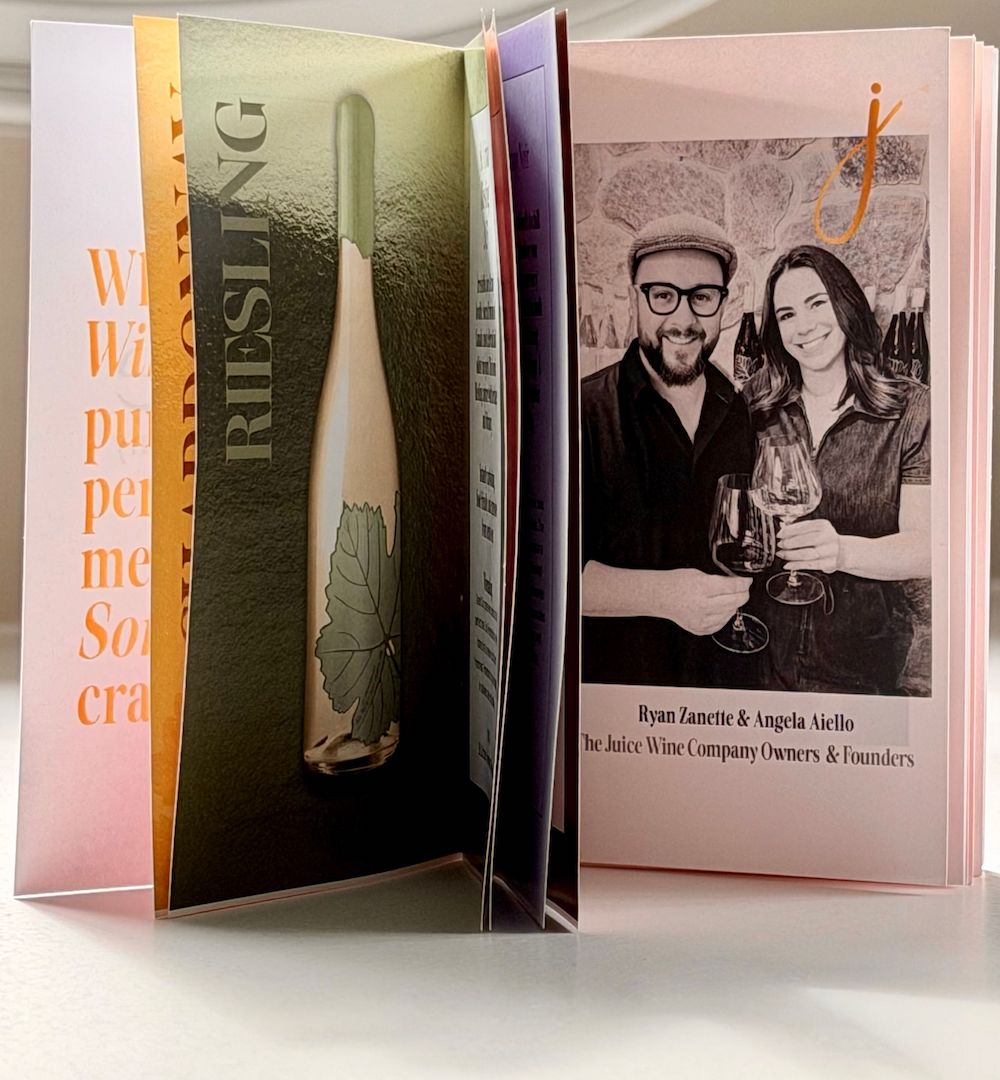
Juicy fact No. 2: Aiello and Zanette also created a little, pink book outlining their journey, their wines, their philosophy — it’s part educational, part fancy and part fun.
Juicy fact No. 3: The Juice Wine Company gives back. A dollar from every bottle sold goes to a national charity. YouthLEADArts is dedicated to empowering underserved youth, in particular Indigenous youth, through arts education. Aiello sits on the board along with teachers across Turtle Island.
Follow the leaf … Sip the story
(5 Juice Wine Co. wines in review)

Juice Wine Co. Chardonnay Twenty Mile Bench 2024 ($33, 91 points) — A fresh and flirty version of Chardonnay with apple and citrusy grapefruit flavours spiced up with a touch of ginger on the finish. Stainless steel fermented, full malolactic conversion to add softness, and partial oak ageing (neutral) for mid-palate texture.
Juice Wine Co. Cabernet Franc Rosé Wismer-Cuesta Vineyards 2025 ($33, 92 points) — Delightfully juicy and fun, this rosé is brimming with sun-warmed strawberries, Jolly Rancher watermelon flavours and savoury herbs. Whole berry pressed and stainless steel fermented to preserve the fruit character. A small portion was aged in neutral barrels for texture and then blended back. A perfect glass for the patio or paired with charcuterie.
Juice Wine Co. Gamay Noir 2024 (sold out, 91 points) — An earthy rendition of this lively, chillable, light-bodied red wine offering berry and peppercorn savoury flavours, with a hint of flintiness. Partial carbonic fermentation and early pressing was used to maintain a low-tannin style followed by barrel fermentation to add texture, and malolactic conversion to round out the acidity.
Juice Wine Co. Cabernet Franc Schenck Vineyards 2025 (sold out, 93 points) — Lively and layered with berry fruit, cranberry, oregano and rosemary. This is a juicy, medium bodied red wine that’s slightly earthy, enveloped in soft tannins that still hold a grip on the finish. (Aged in neutral oak.)
Juice Wine Co. St. Urban Riesling 2025 ($33, 94 points) — Bursting with floral notes, citrus and green apple, this is a sophisticated wine with ample body and texture. When you start with Grand Cru grapes … everything falls in line. An expressive and finely tuned dry Riesling (9 g/L residual sugars).
Note: Wines can be purchased at the Crush or here online.
Comment here